Quick Summary
Pre-kindergarten students benefit most when their classroom experience balances early literacy, number sense, and multi-step direction following with equally important social, emotional, and creative growth. Skills like fine motor development, self-help independence, and confident self-expression matter just as much as recognizing letters or counting accurately. These goals develop best through hands-on, sensory rich learning rather than repetitive drills alone. Smart Start Academy structures its pre-kindergarten program around these exact learning objectives, giving children a well rounded foundation that prepares them for a smooth, confident transition into kindergarten classrooms.
Ask any pre-kindergarten teacher what keeps parents up at night, and the answer is almost always the same: am I doing enough to prepare my child for kindergarten? The truth is that readiness looks different for every child, but there are a handful of core skills that consistently show up on every kindergarten teacher's wish list.
Knowing what pre-k students should know before that first day gives parents a clearer, calmer roadmap instead of a vague sense of worry. Here at Smart Start Academy, our pre-kindergarten classrooms are built around these exact learning goals, developed alongside our experienced educators. Parents who want a starting point can also review our preschool readiness checklist.
1. Recognizing Letters and Early Sounds
By the end of pre-kindergarten, most children can recognize the majority of uppercase and lowercase letters and connect at least some letters to their corresponding sounds. This foundational skill sets the stage for reading fluency in kindergarten and first grade.
Daily storytime, alphabet games, and hands-on letter tracing activities help build this recognition naturally over the course of the year.
2. Counting and Early Number Sense
Pre-K students should be comfortable counting to twenty or higher, recognizing numerals, and understanding basic concepts like more, less, and equal. Early number sense also includes simple sorting and pattern recognition, skills that later support more complex math reasoning.
Hands-on manipulatives, counting songs, and everyday routines like counting snacks at the table reinforce these ideas in a natural, low pressure way.
3. Following Multi-Step Directions
Kindergarten classrooms move quickly, and teachers often give instructions that involve two or three steps at once.
Pre-K students benefit greatly from practicing multi-step directions in a supportive setting, whether that means cleaning up in a specific order or completing a sequence of classroom tasks.
This skill directly impacts how smoothly a child adjusts to a busier, less individualized kindergarten schedule.
4. Building Social and Emotional Skills
Academic readiness is only part of the picture. Children entering kindergarten need to know how to share, take turns, resolve small conflicts, and express their feelings appropriately. Our educators guide children through these moments daily, modeling patience and healthy communication so that students build genuine confidence in group settings rather than simply memorizing rules.
5. Developing Fine Motor Skills
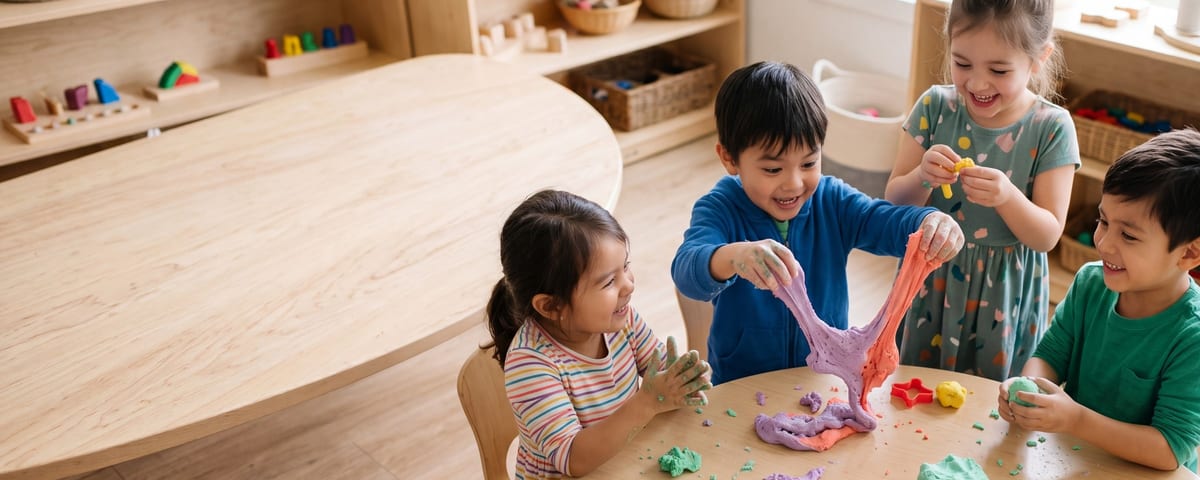
Holding a pencil correctly, using scissors safely, and manipulating small objects all require fine motor development that takes consistent practice. Activities like lacing cards, playdough sculpting, and drawing exercises strengthen these small muscles well before a child is expected to write full sentences.
Our STEM Exploration enrichment offering incorporates hands-on building and problem solving tasks that also happen to strengthen these same motor skills.
6. Practicing Independence and Self-Help Skills
Kindergarten teachers expect students to manage basic self-help tasks largely on their own, including using the restroom independently, putting on a jacket, and managing their own belongings.
Pre-K classrooms intentionally build these routines into the day, encouraging children to problem solve minor challenges before immediately asking for help. This independence reduces anxiety and builds genuine confidence heading into a new classroom environment.
7. Exploring Creativity and Expression
A well rounded pre-K experience nurtures a child's imagination alongside their academic skills. Through Music & Movement activities and open ended art projects offered in our Creative Arts enrichment program, children learn to express ideas, emotions, and stories in ways that words alone cannot always capture.
This creative confidence often translates into stronger communication skills across every subject area later on.
Why Sensory Learning Supports These Goals
Many of the skills above develop most naturally through sensory-rich, hands-on learning rather than rote memorization. Young children learn by touching, moving, observing, listening, and experimenting with materials around them.
These experiences give them opportunities to practice fine motor coordination, strengthen hand-eye coordination, follow directions, and develop early problem-solving skills in ways that feel engaging and age-appropriate.
Incorporating sensory play in preschool can also encourage children to communicate their observations, make choices, and build confidence as they interact with different textures, sounds, shapes, and movements.
Sensory activities can complement early academic instruction by giving children practical ways to apply concepts they encounter during classroom lessons. Sorting objects, manipulating materials, exploring patterns, or using movement to understand simple instructions can reinforce foundational skills while keeping children actively involved.
This hands-on approach can make learning more meaningful and give pre-K students valuable practice with the attention, coordination, curiosity, and independence they will use as they transition into kindergarten.
How Smart Start Academy Brings These Goals to Life
At Smart Start Academy, our pre-kindergarten curriculum is built around the foundational skills children need as they prepare for kindergarten. Rather than separating academic learning from play, our teachers integrate literacy, early math, communication, social development, and creative expression throughout the day.
Children can practice recognizing letters while reading stories, explore numbers through hands-on activities, and strengthen communication skills during group discussions and collaborative play.
Creative projects give children opportunities to make choices, follow directions, and express their ideas while developing fine motor coordination. Daily routines also encourage independence, cooperation, and classroom readiness.
Give Your Child a True Smart Start
Curious to see these learning goals in action? Explore our full enrollment options and discover how Smart Start Academy prepares pre-K students with the confidence, curiosity, and skills they need for a successful kindergarten transition.